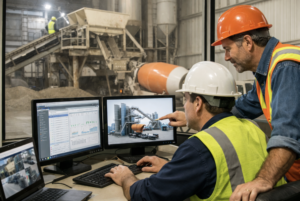
When people hear the term IT, they often think about office networks, help desks, software updates, and cybersecurity. That definition is not wrong, but it is far too small for the real role IT now plays in industrial operations. Even Wikipedia frames information technology as the broader use of computers, telecommunications, and systems for storing, processing, retrieving, and transmitting information. In practical terms, that means IT is no longer sitting on the sidelines. It is now directly tied to how facilities operate, how decisions get made, and how companies stay competitive in demanding industries. That is especially true for North Dakota Concrete Batching Plants, where performance, timing, durability, and communication all matter every single day.
Concrete batching is a business where small breakdowns can create large consequences. Delays in material flow, inconsistent mix data, disconnected field communication, poor maintenance visibility, and outdated control systems can all slow production and increase costs. In a market where digital transformation has become a strategic priority across construction and industrial sectors, IT is not a luxury layer added after the fact. It is part of the operating foundation. That is why anyone following major technology coverage from sources such as InformationWeek and CIO can see the same pattern over and over again: business performance is increasingly tied to smarter systems, cleaner data, and stronger infrastructure.
IT Creates Real-Time Visibility Across Plant Operations
Concrete batching plants run best when the right people can see the right information at the right time. That sounds simple, but in many operations, critical details still live in scattered spreadsheets, text messages, paper tickets, disconnected control interfaces, or the memory of one experienced employee. IT changes that by turning isolated bits of information into connected operational visibility. When a plant can track production data, maintenance status, inventory movement, scheduling updates, and delivery coordination in one organized system, management has a much clearer picture of what is happening and what needs attention next. McKinsey has noted that digital transformation in construction works best when it focuses on actual pain points and collaboration rather than isolated technology pilots. That is exactly where strong IT makes a measurable difference.
For North Dakota operations, visibility matters even more because the margin for disruption can feel smaller. A batching plant is not just a place where materials are mixed. It is part of a larger system involving contractors, transportation, jobsite timing, crew coordination, weather realities, and customer expectations. If one piece of that chain falls behind, the rest of the day can start slipping with it. Good IT infrastructure helps prevent that by making information easier to access, easier to trust, and easier to act on. That includes production monitoring, dispatch coordination, equipment diagnostics, and shared dashboards that reduce guesswork. It also aligns with the broader conversation happening across The Verge and TechCrunch, where modern business technology is increasingly defined by speed, connected systems, and practical operational intelligence.
IT Helps Plants Operate Better in Demanding Conditions
North Dakota is not a market where businesses can afford sloppy operations. Weather, distance, project timing, supply logistics, and equipment stress all push plant performance harder. In that kind of environment, IT matters because it improves responsiveness. Edge computing, industrial IoT, and connected operational systems allow facilities to work closer to the point where data is created, which supports faster decisions and more reliable action. IBM describes edge computing as bringing applications closer to data sources, improving response times and operational benefits, while its industrial and smart manufacturing materials explain how connected systems can monitor equipment and performance in real time. For a batching plant, that means less waiting, better awareness, and a stronger ability to catch problems before they become expensive disruptions.
This is where IT stops being a background function and becomes part of plant strategy. If moisture readings, maintenance indicators, dispatch timing, production throughput, and quality control data are easier to monitor in one environment, managers can make better calls under pressure. They do not have to rely on delayed reports or fragmented communication. They can respond with confidence because the system is built to support faster clarity. That is a major advantage in any batching environment, but it becomes even more valuable in a region where downtime can ripple across multiple crews, customers, and schedules.
Cybersecurity Is Now a Plant Issue, Not Just an Office Issue
One of the biggest reasons IT matters for concrete batching plants is cybersecurity. This is no longer something that only concerns financial institutions, e-commerce brands, or software companies. As industrial environments become more connected, the line between IT and operational technology grows thinner. NIST’s Cybersecurity Framework 2.0 is designed to help organizations manage and communicate cyber risk, and CISA specifically provides guidance for securing industrial control systems. Deloitte also notes that manufacturing and industrial environments face growing cyber risks because connected devices and integrated control systems expand the threat surface. For a batching plant, that matters because interruptions to control systems, access management, network integrity, or connected devices can affect real-world output, real-world safety, and real-world revenue.
In plain terms, if a plant is using modern batching controls, remote access tools, cloud-connected data systems, or integrated production software, it needs more than a basic antivirus mindset. It needs structured governance, role-based access, reliable backups, patching discipline, network segmentation, and clear incident response planning. Those are not abstract IT checkboxes. They are business protections. Publications such as WIRED and Ars Technica regularly cover how fast-moving enterprise technology creates new operational and security challenges, and that same reality applies to industrial environments that depend on connected systems. A modern plant cannot afford to treat cybersecurity as someone else’s department.
IT Supports Automation, Accuracy, and Better Decision-Making
Better IT does not just protect the plant. It also improves the quality of decisions being made inside it. Automation works best when it is supported by clean data, stable systems, and a clear operating model. InformationWeek’s coverage of IT automation reflects a larger reality in business technology: automation is valuable when it is disciplined, integrated, and connected to real outcomes. In a batching plant, that can include automated reporting, inventory alerts, maintenance reminders, remote monitoring, or performance dashboards that help teams identify patterns before those patterns become losses.
That matters because concrete operations are deeply dependent on consistency. IT helps standardize that consistency. It allows plant teams to record what happened, compare it to what should have happened, and refine operations over time. Strong data systems can support mix traceability, equipment performance analysis, and scheduling coordination in ways that manual systems struggle to match. As IBM’s industry resources note, Industry 4.0 and edge-enabled manufacturing are built around faster analysis near the source of operations. That is a practical advantage for batching plants that want to reduce waste, improve uptime, and support better performance without relying on guesswork.
IT Improves Customer Service and Business Reputation
A concrete batching plant is judged by more than what happens inside the yard. It is judged by how reliably it serves contractors, project managers, and jobsite timelines. This is another reason IT matters so much. The better a plant can manage information, the better it can communicate with customers, coordinate deliveries, respond to changes, and maintain confidence when schedules get tight. McKinsey has written about the growing role of integrated platforms in construction technology, and CIO’s ongoing enterprise coverage reinforces the point that technology leadership is increasingly about redesigning work itself, not just installing tools. In other words, IT shapes the customer experience because it shapes how work moves through the business.
For North Dakota concrete batching plants, that can translate into smoother dispatching, fewer avoidable errors, faster communication with field teams, better visibility into service status, and stronger trust from the companies relying on timely concrete supply. When customers believe a plant is organized, responsive, and technically competent, that belief strengthens the brand. It supports referral value, repeat business, and a reputation for reliability. IT may not pour the concrete, but it absolutely helps build the confidence behind the service.
The Strongest Plants Will Treat IT as Core Infrastructure
The old way of thinking treated IT as support. The smarter way treats IT as infrastructure. That distinction matters. A plant can have good people, good equipment, and strong demand, but if its systems are disconnected, outdated, insecure, or difficult to trust, growth becomes harder to manage. McKinsey’s work on construction technology repeatedly points to the value of digital integration, collaboration, and operational clarity. NIST and CISA reinforce the importance of resilience and structured security in connected environments. Together, those themes lead to one conclusion: IT is now part of operational excellence.
For companies serving this space, that creates an important opportunity. An IT website speaking to the concrete and construction market is not stretching its relevance by covering batching plants. It is speaking directly to a sector that increasingly depends on networks, controls, cybersecurity, edge systems, cloud visibility, and reliable data practices. The plants that understand this shift will be better positioned to scale, protect margins, strengthen service, and adapt to what comes next.
Conclusion
IT matters for North Dakota concrete batching plants because batching is no longer just a mechanical function. It is an information-driven operation. The plants that perform best are not only mixing accurately. They are also managing data better, communicating faster, protecting systems more effectively, and making smarter decisions across the full production chain. From cybersecurity and automation to visibility and customer coordination, IT now plays a direct role in plant performance. On an IT website, this topic is not a side conversation. It is a strong example of how technology now supports the physical industries that keep real projects moving.