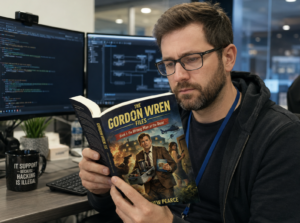
There is a special kind of tired that only an IT manager understands.
It is not the same as being physically exhausted after mowing the yard or spending a Saturday moving furniture. This is a different kind of tired. It comes from explaining for the fourth time that restarting the computer is not a personal attack. It comes from discovering that the urgent system emergency began three weeks ago but apparently became urgent seven minutes before someone important needed the system.
Then there are the passwords.
The forgotten passwords. The expired passwords. The passwords written on sticky notes under keyboards. The person who insists the system changed their password without permission, only to remember twenty minutes later that they changed it themselves.
By the end of the day, an IT manager may not want another leadership book, technology manual, or article about improving productivity. Sometimes the brain needs something completely different.
That is exactly where The Gordon Wren Files: Book 1: The Wrong Man at the Door fits in.
For IT professionals looking through spy thriller books for a story that feels intelligent, fast-moving, and strangely relatable, Gordon Wren may be the accidental hero they did not realize they needed.
He is not James Bond.
He does not enter a room wearing a tuxedo with an exploding fountain pen in his pocket.
He notices that something does not make sense.
For an IT manager, that may be the most believable superpower a character can have. 🖥️
IT Managers Spend Their Entire Careers Noticing What Other People Miss
The official definition of information technology management on Wikipedia covers the management of technology resources according to the needs and priorities of an organization. That sounds very professional and orderly.
Real life tends to be less orderly.
An IT manager can walk into a meeting and notice that everyone is discussing a software problem while quietly realizing the real problem is a broken process. A department may insist that a system is too slow when the actual issue is that six people are entering the same information in six different ways. Someone may blame the server while the IT manager is already staring suspiciously at a spreadsheet created in 2009.
That ability to see beyond the obvious is one reason Gordon Wren is such an entertaining character.
In The Wrong Man at the Door, Gordon is on a work trip connected to an international summit when ordinary details begin stacking up in very unordinary ways. A suspicious house, problems surrounding a hotel, questionable logistics, and normal service traffic begin to form a much larger picture. The people around Gordon repeatedly assume he must have some type of advanced training because of what he notices. The truth is considerably less glamorous. He pays attention, understands systems, and recognizes when the pieces do not belong together.
That sounds remarkably familiar to the person sitting in the IT department.
IT managers often live in the space between what people think is happening and what is actually happening.
Gordon does too.
The Story Understands the Difference Between a Problem and the Real Problem
Every IT manager has received a support request that identifies the wrong problem.
“The internet is down.”
The internet is not down.
“The software deleted my report.”
The software did not delete the report.
“The computer is broken.”
The monitor is turned off.
This is not a criticism of users. People normally describe problems based on what they can see. IT professionals learn to look underneath the visible symptoms.
According to the U.S. Bureau of Labor Statistics, computer and information systems managers plan, coordinate, and direct computer-related activities within organizations. The BLS also projects employment in the field to grow 15 percent from 2024 to 2034, much faster than the average for all occupations.
The job requires more than knowing how technology works. It requires understanding how separate systems, people, departments, and decisions affect one another.
That same basic idea makes The Wrong Man at the Door work so well as a thriller.
Gordon is not simply reacting to a man standing at a door or one strange event. He begins connecting details. Service traffic has a purpose. Hotels have routines. International events create predictable activity. Equipment belongs in certain places for certain reasons.
When those patterns stop making sense, Gordon notices.
The best part is that he does not suddenly transform into an invincible action hero. He remains Gordon. He is a practical man dealing with a situation that has become increasingly impractical.
For an IT manager who has ever watched a minor ticket somehow reveal a department-wide failure, there is something deeply satisfying about that.
Gordon Wren Has the Troubleshooting Brain
Troubleshooting is almost a personality trait in IT.
A normal person sees a printer that will not print.
An IT manager sees a list.
Power.
Connection.
Driver.
Print queue.
Permissions.
Network.
Recent changes.
User behavior.
The problem is slowly divided into possibilities until the impossible-looking situation becomes manageable.
The O*NET profile for Computer and Information Systems Managers describes the role as planning, directing, or coordinating work involving information systems, systems analysis, programming, and related technology activities.
Systems analysis matters because complicated problems are rarely solved by staring dramatically into the distance.
They are solved by examining details.
Gordon Wren approaches danger with that type of brain.
Something happens.
He notices it.
Something else happens.
He compares the two.
A detail that appeared meaningless suddenly becomes important.
That is an extremely different type of thriller hero. Gordon does not have perfect information. He simply refuses to ignore information because it looks boring.
In the real world, boring details are often the important ones.
A strange login.
A failed backup.
An employee account behaving differently.
A piece of equipment appearing where it should not be.
A routine process that has quietly changed.
IT managers understand that one unusual detail does not always mean disaster. They also understand that five unusual details may deserve attention.
Gordon understands the same thing.
🔍 That may be why reading his story feels less like watching an impossible superhero and more like watching an extremely observant coworker accidentally wander into international trouble.
IT Managers Already Understand That Security Is About More Than Technology
Modern IT leadership has changed.
Security is no longer something that can be placed in a small box labeled “firewall” and forgotten until the next budget meeting.
The NIST Cybersecurity Framework is designed to help organizations understand and improve the management of cybersecurity risk. NIST’s CSF 2.0 emphasizes high-level outcomes that organizations can use to assess, prioritize, and communicate cybersecurity efforts.
That word “manage” matters.
Technology is involved, but so are people, processes, procedures, vendors, access, communication, and physical operations.
The Cybersecurity and Infrastructure Security Agency also provides guidance focused on protecting people, customers, intellectual property, and sensitive data from cyber and physical threats.
IT managers live with the knowledge that security problems can enter an organization through perfectly ordinary doors.
Sometimes literally.
The Wrong Man at the Door builds tension around ordinary things that begin to look different when viewed in context. Hotel operations, service routes, domestic equipment, conference materials, and logistics become pieces of something much larger.
That is especially effective for technology professionals because IT managers understand that threats do not always arrive wearing a sign that says THREAT.
A phishing email tries to look like an ordinary email.
A compromised account tries to behave like a real user.
Malicious activity often hides inside legitimate processes.
The danger in Gordon’s world works because it hides in normal activity.
That makes the story more unsettling.
It also makes it much smarter.
After Fixing Everyone Else’s Problems, It Is Nice to Watch Someone Else Inherit the Disaster
There is a moment in many IT managers’ days when the brain simply reaches capacity.
A meeting could have been an email.
The email could have been two sentences.
One of those sentences could have been deleted.
Meanwhile, a system migration is behind schedule, a vendor has used the phrase “known issue,” and someone has opened a ticket titled “HELP.”
This is when reading another serious article about digital transformation may not be the answer.
Even Cisco’s explanation of cybersecurity emphasizes the convergence of people, processes, and technology in protecting organizations.
IT managers spend their days standing in the middle of those three things.
People.
Processes.
Technology.
By 6:00 p.m., the people may be winning.
Reading about Gordon Wren offers a different kind of mental escape because his problems are considerably worse.
Your password reset ticket suddenly feels peaceful.
Nobody has hidden an international conspiracy in the server room.
Probably.
The conference room printer is annoying, but at least Gordon Wren is dealing with criminal operations hidden behind seemingly legitimate logistics.
Perspective is a beautiful thing. 😄
The humor surrounding Gordon also helps. The Wrong Man at the Door does not require the reader to believe Gordon is the world’s greatest intelligence operative. Other characters may suspect that he is hiding advanced training, but Gordon’s effectiveness comes from practical thinking and observation.
IT managers have spent years being called “computer geniuses” after plugging in an unplugged cable.
They understand Gordon’s situation.
The Accidental Expert Is an Extremely Relatable Hero
There is another reason Gordon connects so well with IT leadership.
Competence attracts responsibility.
An IT manager fixes one problem and is immediately invited to help with another.
Then another.
Eventually the IT department is involved in the phone system, building access, conference room televisions, digital signage, the CEO’s home Wi-Fi, and a coffee machine that has an app.
Nobody remembers how this happened.
It simply happened.
Gordon’s journey has a similar sense of escalation. He notices something unusual. That observation leads to another problem. His ability to think through the problem makes people believe he knows more than he does.
Soon, the situation is much larger than the thing that originally caught his attention.
Every IT manager who has ever said, “I was just helping them connect to the network,” will understand this progression.
The technology industry often celebrates specialists, but IT managers frequently survive by developing broad situational awareness. They know enough about infrastructure to recognize a problem. They understand security. They manage vendors. They communicate with executives. They help users. They evaluate risk.
The role naturally trains people to ask what connects to what.
Gordon Wren lives by the same mental habit.
One detail connects to another.
One person connects to a larger operation.
One location connects to a pattern.
The tension grows because Gordon sees the connections before he fully understands what they mean.
That is exactly the kind of suspense an analytical reader can appreciate.
It Is a Thriller That Respects the Reader’s Brain
Some thrillers rely almost entirely on explosions.
An explosion occurs.
The hero runs.
Another explosion occurs.
The hero runs in a slightly different direction.
There is nothing wrong with that kind of story. Sometimes an exploding helicopter is exactly what the evening requires.
The Wrong Man at the Door takes a different route.
The intrigue develops through observations, unusual activity, and the growing realization that ordinary environments are being used to hide something dangerous. The international summit setting creates a world where legitimate security concerns, high-end locations, and complex logistics naturally overlap.
An IT manager can enjoy that kind of story because the reader gets to participate mentally.
Details matter.
Processes matter.
The environment matters.
The reader has room to notice things alongside Gordon.
That makes the book a good choice after a mentally demanding day because it does not insult the reader’s intelligence, but it also does not feel like homework.
There are no quarterly objectives to prepare.
There is no change management meeting.
Nobody is asking for a three-year infrastructure roadmap.
There is simply a normal man who noticed something was wrong and made the unfortunate decision to keep paying attention.
📚 That is a much better way to spend the evening.
IT Managers Deserve a Hero Who Solves Problems Without a Cape
IT managers rarely get dramatic entrances.
Nobody applauds when the network stays online.
There is no standing ovation because backups completed successfully.
When a major project launches without problems, people often assume the project must have been easy.
When something fails, the IT manager receives twelve messages before the monitoring system finishes sending the first alert.
It is a career built around solving problems that other people may never completely understand.
That is why Gordon Wren feels refreshing.
His greatest advantage is not a gadget built by a fictional intelligence agency. It is the ability to observe how things normally work and recognize when they are no longer working normally.
He is practical.
He is persistent.
He is in considerably more trouble than he expected.
That is a solid hero for the IT crowd.
Conclusion: Put Down the Support Ticket and Pick Up The Wrong Man at the Door
After a day of fixing everyone else’s problems, IT managers deserve a story where somebody else has inherited the impossible situation.
The Wrong Man at the Door delivers a spy thriller built around observation, logic, systems, and ordinary details that slowly reveal something much more dangerous. Gordon Wren is not presented as an untouchable super-spy. He is a man whose practical way of thinking keeps pulling him deeper into a world where people assume he must know exactly what he is doing.
IT managers should find that painfully relatable.
The book offers suspense without requiring the reader to abandon common sense. It gives analytical minds details to follow, patterns to notice, and a hero who understands the value of looking twice when something does not feel right.
Most importantly, it provides an escape from the daily cycle of tickets, passwords, meetings, vendors, updates, warnings, and mysterious problems that disappear the second someone from IT walks into the room.
The servers will still be there tomorrow.
The support queue will survive.
Someone will absolutely forget a password.
For tonight, let Gordon Wren fix the problem.
He has a much bigger one. 🔐