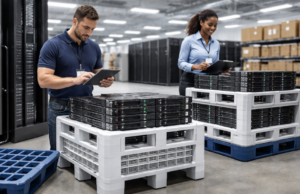
The IT world is moving fast, and the companies operating in it are under pressure from every direction. Recent reporting from Reuters, AP News, and The Wall Street Journal shows how much capital, urgency, and operational complexity are flowing into AI infrastructure, enterprise systems, and data-center expansion. That larger business reality affects more than software strategy. It also affects the physical spaces where IT businesses store equipment, stage deployments, protect components, and move valuable assets from one point to another.
For many IT businesses, storage is treated like a background detail until it becomes a real problem. A warehouse starts looking cluttered. Devices sit on mismatched skids. Returned hardware stacks unevenly. Sensitive components move through spaces that are harder to keep clean than they should be. Teams waste time making standard pallets work for loads they were never designed to carry. In an industry built on precision, uptime, and trust, sloppy storage sends the wrong signal internally and externally.
That is where custom plastic pallets make a real difference. They bring structure to environments that need to stay organized, cleaner, and safer without adding unnecessary friction to daily operations. When an IT business uses the right pallet system, storage becomes more than a place to set things down. It becomes part of a smarter workflow that supports inventory control, equipment protection, technician efficiency, and a more polished operation overall.
Why Physical Storage Matters More in IT Than People Think
IT businesses do not just manage code, cloud services, tickets, and remote support. Many also manage hardware, replacement parts, networking gear, staging materials, monitors, laptops, printers, access-control systems, server components, point-of-sale equipment, and outbound installations. Managed service providers, enterprise resellers, repair operations, structured cabling teams, and data-center support companies all rely on physical movement behind the scenes. If the physical side of the business is disorganized, it eventually shows up in delayed installs, damaged assets, confusing inventory counts, and teams spending valuable time fixing avoidable issues.
That reality becomes even more important as IT operations grow more demanding. Coverage from TechCrunch and CRN reflects how quickly enterprise software, AI tools, and IoT ecosystems are evolving. A practical inference from that broader trend is that more IT businesses will be handling more devices, more edge equipment, and more infrastructure-related logistics than before. The physical layer of the business cannot stay outdated while the digital layer keeps accelerating.
A cleaner, better-designed pallet system helps bring consistency to that physical layer. It gives teams a defined footprint for how equipment is stored, staged, moved, and counted. It reduces the improvisation that often causes clutter and confusion. It also supports a more scalable operation, which matters when a company is trying to grow without turning the warehouse, back room, or staging area into a constant bottleneck.
Cleaner Storage Supports Better IT Environments
Cleanliness matters in IT more than many companies admit. Even when a business is not operating a sterile environment, it is still dealing with equipment that performs better when it is kept off dirty floors, away from moisture exposure, and stored in a more controlled way. Hardware may arrive boxed, but that does not mean it should sit on rough, dusty, splinter-prone surfaces while waiting to be installed, reconfigured, or shipped back out.
According to Wikipedia’s overview of pallets, plastic pallets are valued for advantages such as easier sanitation, resistance to odor, and resistance to weathering, rot, chemicals, and corrosion compared with traditional wood options. Those qualities line up well with the needs of IT businesses that want a storage environment that feels more controlled and easier to maintain.
This is one reason many operations benefit from using Custom Pallets built for their exact use case instead of forcing equipment onto one-size-fits-all platforms. When pallets are designed around the dimensions, weight patterns, and movement needs of the products being stored, the result is a neater footprint and a more intentional environment. That matters for staging server hardware, organizing return merchandise authorization inventory, housing replacement parts, or keeping client-bound equipment ready for deployment.
Cleaner storage also has a perception benefit. An IT business that keeps its equipment organized on well-designed plastic pallets looks more trustworthy to clients, vendors, partners, and even its own team. A tidy warehouse or storage room reinforces the message that the company is careful with systems, assets, and details. In a relationship-driven business, perception is not fluff. It is part of credibility.
Safer Storage Protects People and Equipment
Safety is another major reason IT businesses should take pallet selection seriously. Traditional wood pallets may be common, but common does not always mean ideal. In environments where teams are frequently moving equipment, staging installations, handling boxed electronics, or reworking returned hardware, the condition and consistency of the pallet underneath the load matters.
A more standardized plastic pallet setup can help reduce some of the everyday problems that come from damaged or inconsistent pallets. Teams are less likely to deal with splinters, broken deck boards, or protruding nails. Loads can be staged more evenly when the pallet is built to support the actual product profile instead of something roughly similar. That can contribute to better handling habits and lower risk during internal movement.
Equipment protection matters just as much as worker safety. IT hardware is expensive, and even when it is boxed, it is still vulnerable to avoidable drops, tilts, shifting, and poor stacking practices. Custom plastic pallets can help create a more stable base for cartons, cases, bins, and reusable packaging systems. That is especially useful when a company routinely moves gear between receiving, testing, configuration, deployment, repair, and outbound shipping.
Security concerns in IT also make disciplined physical handling more important. Reuters recently reported on a U.S. agency urging companies to strengthen security around Microsoft’s endpoint management environment after a cyberattack on Stryker, and Reuters separately reported rising demand for advanced protection as AI-driven cyber threats grow. Those reports are about digital risk, but the practical lesson is broader: IT businesses are operating in a high-trust environment where control, accountability, and process matter. Physical asset handling should reflect that same standard.
Smarter Storage Creates Better Workflow
A smarter pallet strategy is not only about what happens in the warehouse. It affects how fast teams can locate assets, how clearly items can be categorized, and how easily operations can scale. Standard pallets often leave IT businesses adapting their workflow around the pallet. Custom plastic pallets let the business design storage around the workflow instead.
That difference matters when items need to be grouped by project, client, deployment schedule, device type, or service status. It matters when businesses want cleaner aisles, better stackability, and more predictable footprints for shelving, racking, or staging zones. It matters when internal teams need to identify at a glance what is install-ready, what is waiting on parts, what is return inventory, and what is reserved for a scheduled rollout.
Custom sizing also makes sense for businesses dealing with unusual cartons, mixed hardware kits, cable assemblies, rack accessories, small-footprint electronics, or reusable transport packaging. Instead of wasting floor space or creating unstable loads, companies can use pallet designs that actually fit the way their products are packed and moved. That can lead to better density, better flow, and fewer workarounds.
There is also a long-term operational payoff. Smarter storage reduces the mental load on staff. People do not have to guess where things belong or create temporary fixes that become permanent messes. A consistent pallet system supports standard operating procedures, cleaner receiving areas, more organized deployment prep, and better reverse logistics when equipment comes back from the field.
Why Custom Plastic Pallets Fit the Direction IT Businesses Are Headed
The broader IT business landscape keeps moving toward scale, automation, and tighter operational expectations. Whether a company focuses on managed services, enterprise deployment, hardware distribution, device lifecycle services, or data-center support, clients expect reliability. They expect readiness. They expect systems that look intentional.
That is one reason infrastructure discipline matters. As Reuters has reported, organizations are continuing to spend in response to escalating cyber threats, and as Reuters has also reported, software companies are actively adapting to AI pressure rather than standing still. Those are different stories, but together they show a common theme: IT businesses are being pushed to become sharper, more resilient, and more deliberate in how they operate. A cleaner and more reliable physical storage system supports that direction.
Custom plastic pallets fit that future because they help eliminate the mismatch between modern operations and outdated storage habits. They can be designed around specific load capacities, footprints, and handling requirements. They can help create a more polished facility. They can support cleaner environments and more consistent movement. Most importantly, they help an IT business act like a company that values order, protection, and readiness at every level.
Conclusion
Custom plastic pallets are not just a warehouse upgrade. For IT businesses, they are a practical operations decision that supports cleaner storage, safer handling, and smarter organization. In an industry where equipment value is high, efficiency matters, and trust is earned through consistency, the right storage foundation can make a meaningful difference.
A business that chooses custom plastic pallets is choosing more than a material. It is choosing a more intentional way to protect equipment, improve workflow, support teams, and present a stronger operation to clients and partners. That is exactly the kind of behind-the-scenes improvement that helps an IT business run better now and scale with more confidence later.